I burned out. Then I built a system. Here’s what happened.
I’m 47 years old, and not long ago a doctor looked at my blood work and my Apple Health metrics, sat back, and told me it was a miracle I was still alive. Then, with the kind of sarcasm you only earn after years in a profession, he added: “Some people win the genetic lottery and they are wasting the prize.”
He was talking about me. I was the one wasting it.
How I got here
For most of my career I lived two contradictory lives at once. On one side, the body of someone who sits at a desk for twelve hours a day — all the quiet damage that comes with a sedentary life. On the other, the mind of someone determined to stay a high performer on cutting-edge projects, often playing every role at once: engineering manager, product owner, architect, whatever the moment demanded. I wasn’t running one organization. I was running several versions of myself, all at the top of their lungs, all the time.
I should have known better.
There’s something pilots experience when they pull high G’s. Their vision tunnels. As the force increases, their field of view narrows, until eventually all they can see is a single point dead ahead. It’s a known, studied effect — for the duration of a maneuver. But I don’t think anyone has ever studied what happens to a person who chooses to live inside that force for years without ever pulling out of the turn.
I can tell you what happens, because I was the experiment.
Three burnouts. A resting heart rate of 90 to 100 that I had quietly accepted as my new normal. An average of five hours of sleep a night, stretched across years. And underneath all of it, a permanent, low exhaustion that I kept answering with more caffeine, and then more than caffeine. My field of view had narrowed down to the single point in front of me, and I called that focus. I called it being good at my job.
The wall
When the doctor said what he said, something landed that hadn’t landed before. I understood, very clearly, that if I didn’t change something, the next fifty years were a big question mark — and not a hopeful one. I was flooring the gas pedal straight toward a wall, and the wall wasn’t theoretical anymore.
But here’s the part that, strangely, gave me something to hold onto. The moment I really looked at the problem, I realized it wasn’t one problem. It was many — nutrition, sleep, my physical state, my psychological state — all tangled together, each one feeding the others, none of them fixable in isolation.
And that felt familiar. That felt exactly like work.
I’ve spent decades untangling systems for a living. Mapping how the pieces connect, where they influence each other, what breaks when you pull on one thread. I knew how to do this. I just had never once pointed those tools at myself. So I decided it was time to use those decades of engineering to engineer the life I actually needed.
Treating myself like a system
The first thing I knew was that I had to map it. Not vaguely “eat better, sleep more” — but actually lay out the problems, see how they connected and influenced each other, and find a way to track them honestly over time. I needed to watch this wreck called Nicolae slowly, consistently move in the right direction, with data instead of guilt.
The second thing I knew was just as important: it had to be low friction. If I built something complicated and demanding, I’d abandon it inside a week, the same way I’ve abandoned every grim “new regime” before. So whatever I built had to tolerate failure. It had to assume I’d fall off, and it had to gently put me back on track instead of punishing me for being human. A system that breaks the first time you miss a day isn’t a system. It’s just another wall.
My work lives deep in the AI world, so the approach almost chose itself. For once I wouldn’t use these tools to build software. I’d use them to do the research I didn’t have the energy or expertise to do alone, and to turn that research into an actual roadmap — one with a realistic timeline of about six months to repair my nutrition, my sleep, and my physical and psychological condition, and to point me in the right direction.
That’s where the Phoenix Protocols came from.
Where I am now
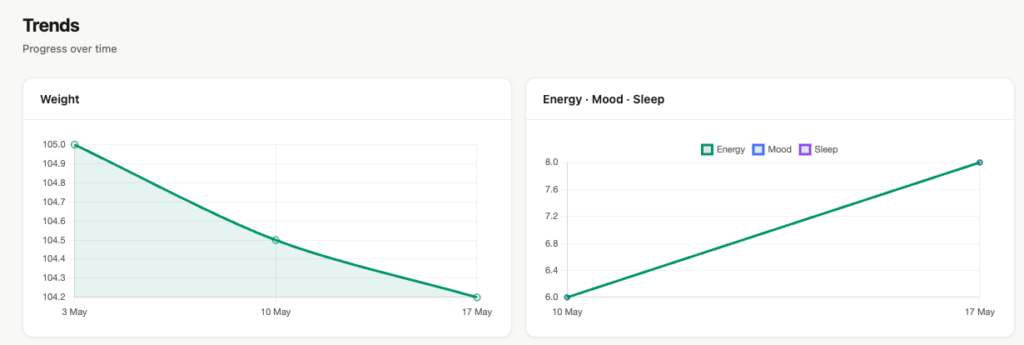
It’s been a little over a month. And the honest truth — the reason I’m finally writing this down — is that the results are already starting to show. Not in some dramatic before-and-after way. In small, real, measurable ways. Enough that I started to think maybe putting this out in the open could help someone who’s sitting exactly where I was sitting, accepting a 100 heart rate as normal and calling exhaustion a personality trait.
I want to be clear about one thing, though. These protocols are not a finished, polished recipe. They’re alive. They’re changing as I learn what actually works for my body and my life, and they’ll probably look different in another month. That’s the point. A good system isn’t a monument. It’s something you keep correcting.
So this is the start. Not the success story — I haven’t earned that word yet — but the moment I finally took my eyes off the single point in front of me and looked up at the whole horizon again.
If you’ve been flying at high G’s for too long, maybe it’s time we both pulled out of the turn.